

Inspections
Did you know it is required by law to have your extinguishers inspected annually?
Like fire alarm systems, states in New England have adopted NFPA-10 (standard for portable fire extinguishers) which makes it the law. Each year, your extinguishers must be inspected by a qualified technician and once the extinguisher passes inspection a new tamper seal is installed on the firing pin and an inspection tag tied to the extinguisher. The extinguisher is good for one year from the date punched on the tag.
Maintainence
Fire extinguishers are required to undergo maintenance at specific intervals from the date of manufacture based on the type. Inspectors will note when these services are due during your annual inspection. From there we can provide pricing and perform these services.

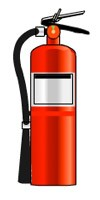
Dry Chemical (ABC Multipurpose)
Dry Chemical fire extinguishers extinguish the fire primarily by interrupting the chemical reaction of the fire triangle.
Today's most widely used type of fire extinguisher is the multipurpose dry chemical that is effective on Class A, B, and C fires. This agent also works by creating a barrier between the oxygen element and the fuel element on Class A fires.
Ordinary dry chemical is for Class B & C fires only. It is important to use the correct extinguisher for the type of fuel! Using the incorrect agent can allow the fire to reignite after apparently being extinguished successfully.

Wet Chemical (Kitchens)
Wet Chemical is an agent that extinguishes the fire by removing the heat of the fire triangle and prevents reignition by creating a barrier between the oxygen and fuel elements.
Wet chemical of Class K extinguishers were developed for modern, high efficiency deep fat fryers in commercial cooking operations. Some may also be used on Class A fires in commercial kitchens.

Clean Agent
Halogenated or Clean Agent extinguishers include the halon agents as well as the newer and less ozone depleting halocarbon agents. They extinguish the fire by interrupting the chemical reaction and/or removing heat from the fire triangle.
Clean agent extinguishers are effective on Class A, B and C fires. Smaller sized handheld extinguishers are not large enough to obtain a 1A rating and may carry only a Class B and C rating.
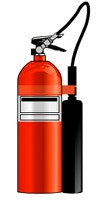
Carbon Dioxide
Carbon Dioxide fire extinguishers extinguish fire by taking away the oxygen element of the fire triangle and also by removing the heat with a very cold discharge.
Carbon dioxide can be used on Class B & C fires. They are usually ineffective on Class A fires due to the possibility of embers reigniting.
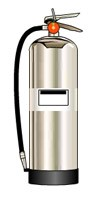
Water and Foam
Water and Foam fire extinguishers extinguish the fire by taking away the heat element of the fire triangle. Foam agents also separate the oxygen element from the other elements.
Water extinguishers are for Class A fires only. They should not be used on Class B or C fires. The discharge stream could spread the flammable liquid in a Class B fire or could create a shock hazard on a Class C fire being extinguished successfully.
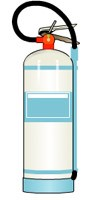
Water Mist
Water Mist extinguishers are a recent development that extinguish the fire by taking away the heat element of the fire triangle. They are an alternative to the clean agent extinguishers where contamination is a concern.
Water mist extinguishers are primarily for Class A fires, although they are safe for use on Class C fires as well.
